
Search
Latest Stories
Don't Miss Out
Get the latest updates and insights delivered to your inbox.

Fortesa Latifi
Fortesa Latifi is a journalist based in Los Angeles, California and a graduate of the Walter Cronkite School of Journalism & Mass Communication. She loves to write about chronic illness, mental health and the way politics affects our daily lives and relationships. You can find her work in Teen Vogue, The Lily and more.
Full BioLearn about our editorial policies
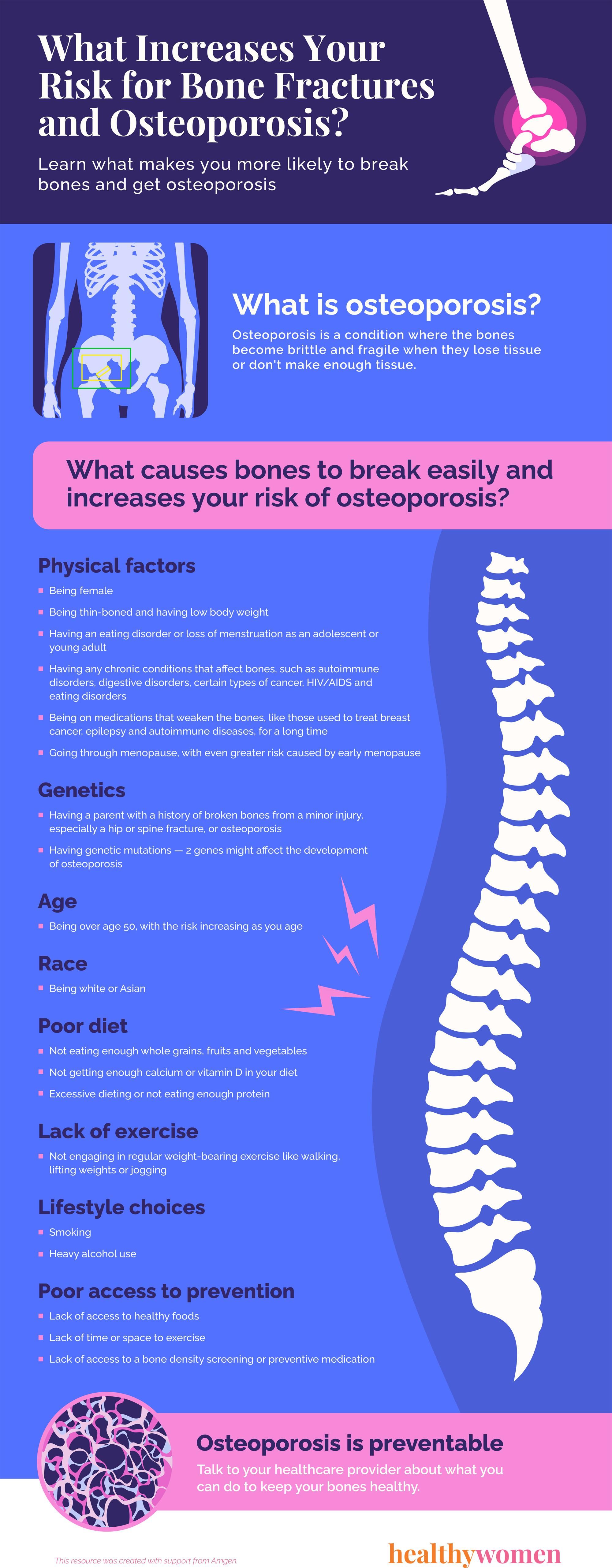
What Increases Your Risk for Bone Fractures and Osteoporosis?
Learn what makes you more likely to break bones and get osteoporosis
What is osteoporosis?
Osteoporosis is a condition where the bones become brittle and fragile when they lose tissue or don't make enough tissue.
What causes bones to break easily and increases your risk of osteoporosis?
Physical factors
- Being female
- Being thin-boned and having low body weight
- Having an eating disorder or loss of menstruation as an adolescent or young adult
- Having any chronic conditions that affect bones, such as autoimmune disorders, digestive disorders, certain types of cancer, HIV/AIDS and eating disorders
- Being on medications that weaken the bones, like those used to treat breast cancer, epilepsy and autoimmune diseases, for a long time
- Going through menopause, with even greater risk caused by early menopause
Genetics
- A parent with a history of broken bones from a minor injury, especially a hip or spine fracture, or osteoporosis
- Genetic mutations — 2 genes might affect the development of osteoporosis
Age
- Being over age 50, with the risk increasing as you age
Race
- Being white or Asian
Poor diet
- Not eating enough whole grains, fruits and vegetables
- Not getting enough calcium or vitamin D in your diet
- Excessive dieting or not eating enough protein
Lack of exercise
- Not engaging in regular weight-bearing exercise like walking, lifting weights or jogging
Lifestyle choices
- Smoking
- Heavy alcohol use
Poor access to prevention
- Lack of access to healthy foods
- Lack of time or space to exercise
- Lack of access to a bone density screening or preventive medication
Osteoporosis is preventable
Talk to your healthcare provider about what you can do to keep your bones healthy.
This resource was created with support from Amgen.
- I Have Postmenopausal Osteoporosis: What I Wish I Had Known ... ›
- Clinically Speaking: Questions to Ask Your Healthcare Provider ... ›
- How Women of All Ages Can Prevent Osteoporosis - HealthyWomen ›
- New Screening Advancements for Osteoporosis and Osteopenia - HealthyWomen ›
If having a simple urinary tract infection (UTI) is unpleasant, does a complicated UTI (cUTI) feel unpleasant in a more confusing way? Urologist Katherine Klos, M.D., empathizes with patients who visit her office with any kind of UTI, whether it’s regular, recurrent or complicated. “No UTI is pleasant,” Klos said. “Complicated just means the infection has spread and created a greater risk for sepsis.”
We spoke with Klos and asked her to explain what makes a UTI complicated, and why cUTIs are more urgent to treat.
What are cUTIs and how are they different from recurrent UTIs?
We think of UTIs as recurrent when a patient has two UTIs within six months or three UTIs within a year. A cUTI means the infection has spread outside the bladder, and that puts the patient at risk for sepsis, which is a life-threatening response to an infection.
With recurrent UTIs, we’re talking about their frequency or how often they happen. With cUTIs, we’re talking about the spread of the infection. Fortunately, cUTIs are less common.
What are the symptoms of cUTIS, and are they different from uncomplicated UTIs?
We can tell a UTI is complicated when we see symptoms like fever, chills, kidney pain or a bladder that won’t clear. The fever is a whole-body response to infection and is a big indicator. In the late stages, or in patients around 70 or older, we’ll sometimes see altered mental status as well.
What causes cUTIs?
Like simple or uncomplicated UTIs, complicated UTIs are caused by bacteria, and the most common culprit is E. coli. Bacteria can get in through a catheter or by a kidney stone that’s causing a blockage in the urinary tract. In women, bacteria can be spread from wiping back to front when using the toilet.
Who is at risk for cUTIs?
Patients who have catheters are at risk for cUTIs. So are patients who have undergone recent urological surgery. Having kidney stones or anything that blocks urine, including an anatomical blockage, can put you at risk as well.
How are cUTIs diagnosed?
Clinicians will look at your symptoms and your lab work. When we see elevated white blood cells in the lab work, that’s the evidence that the infection has spread outside the bladder. We’ll look at those results, and when we’re asking about symptoms, we’ll ask about kidney pain. It’s not routine to do imaging of the kidney, but sometimes that’s done as well.
When should you go see a specialist and what kind of specialist should you see?
You should see a specialist if you’re experiencing symptoms of a cUTI or if you’re getting recurring UTIs. Your first line of defense is a urologist or urogynecologist. If your UTI is resisting treatment or if cUTIs are recurring, an infectious disease specialist would be your next step.
How do you treat cUTIs and is the treatment different than it is for uncomplicated UTIs?
Patients with cUTIs are at risk for sepsis and need to get treated urgently. They will get a longer course of antibiotic therapy, generally between 10–14 days. Until the bacteria that’s causing it has been identified, your medical team will usually prescribe an antibiotic that fights a broad range of bacteria. Uncomplicated UTIs will take a shorter course of antibiotics to resolve the infection, usually between three and seven days.
This educational resource was created with support from GSK.
Fortesa Latifi is a journalist based in Los Angeles, California and a graduate of the Walter Cronkite School of Journalism & Mass Communication. She loves to write about chronic illness, mental health and the way politics affects our daily lives and relationships. You can find her work in Teen Vogue, The Lily and more.
Medically reviewed by Dr. Risa Kagan