Is AI Going to Make Your Doctor Obsolete?
The answer is not as simple as you might think

When a simple medical test flagged that I had a potential heart issue, I fed the report into AI to get immediate answers, instead of waiting to hear from my doctor.
AI explained my diagnosis, what the possible outcomes were and the medications available for treatment. Sounds helpful, doesn’t it?
But it also said the condition causes sudden death and I would require immediate open heart surgery. Forget the diagnosis, that alone almost gave me a heart attack.
Fortunately, AI was a little overzealous. Though it gave me some accurate information, it wasn’t all correct. In fact, my condition was completely controllable with a simple prescription.
According to a KFF Tracking Poll, 1 in 3 adults have used AI in the last year for health information and advice, and 2 out of 3 of those polled said they use AI to find out more about their health concerns before seeing a clinician. With AI becoming more and more advanced, it almost seems like chat bots will replace clinicians one day. Even some clinicians are worried that they’ll eventually become obsolete.
The good news is that’s not likely to happen anytime soon. “For the foreseeable future, there’s so much of what healthcare professionals do that requires judgment,” said Robert Wachter, M.D., chair of the Department of Medicine at University of California at San Francisco, and author of A Giant Leap: How AI is Transforming Healthcare and What That Means for Our Future.
We looked into the research to find out exactly what AI can and cannot do, what the future looks like, and why we’ll always need humans when it comes to healthcare.
Generative AI like Chat GPT, Claude and Gemini can help you understand complex diagnoses and explain test results. “You can essentially speak to them as you would a doctor, a colleague, or a friend, and they give you answers back in plain English,” said Wachter. These tools can also read labs, tell you what your symptoms might mean, and even identify rashes when you upload a photo. This gives people an easier way to access knowledge they might otherwise have to dig for on the internet or wait for a clinician to answer.
Healthcare professionals also rely heavily on AI. A recent survey by the American Medical Association found that over 80% of doctors use AI tools like Open Evidence to compile studies, take patient notes, and streamline administrative tasks like billing and coding. They even use it to identify patient risk factors and create personalized treatment plans based on predictive data. The number of doctors using these types of AI tools is almost double what it was in 2023.
As my scenario showed, AI is smart, but it’s not always accurate. Wachter said that someone who doesn’t have the medical knowledge necessary to ask AI the right questions may walk away with misinformation. “When people use these tools to get medical advice, they often get the wrong advice. When I use the same tool, I’ll often get the right advice because I know what to put in and I know how to interpret the advice.”
Another well-known problem with AI is that it can hallucinate. This means that sometimes the information it provides is completely false. A recent study in BMJ found that when researchers asked medical questions to five different AI chatbots, nearly half the answers were problematic. “It’s good enough to be useful, but not perfect enough to be entirely trusted,” said Wachter.
But one of the biggest issues with AI is that it doesn’t account for gender biases. That’s because most medical data we have today is based on male studies. If AI is using male data to diagnose a woman, she might receive the wrong diagnosis. Wachter said the good news is that you can ask AI to watch out for biases when responding to your questions. “It will do a good job of being reflective about where it got its data from,” he added.
In the near future, Wachter predicts that AI will likely be able to diagnose common issues like a UTI, and even write a prescription for it, potentially reducing healthcare costs and long waiting times.
Eventually, AI will become even more precise when managing chronic conditions, like high cholesterol and high blood pressure. Wearables will more accurately monitor your symptoms and then use your medical data to predict flare-ups and create customized treatment plans. Symptom monitoring, early disease detection and health management will become more personalized as AI algorithms continue to collect and process data. It will also minimize human error and learn to identify and classify diseases that were once difficult to diagnose.
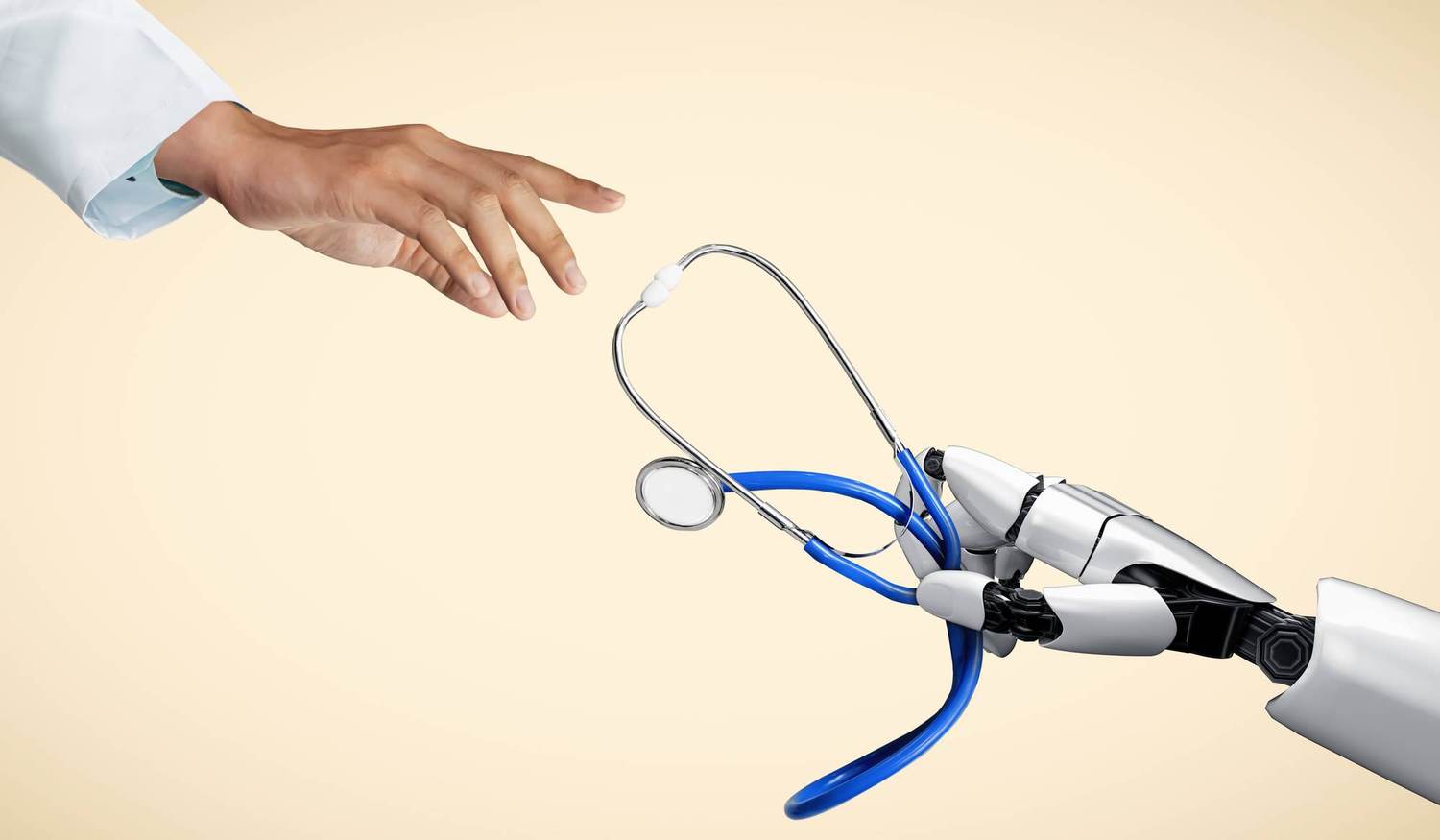
And while we once thought robots were the stuff of science fiction, soon they’ll be able to assist with physical therapy and rehabilitation, interacting directly with patients to guide movements.
AI is also optimizing drug development by rapidly analyzing massive amounts of data to help find new cancer drugs. This is making the process faster, cheaper and more effective. It’s even showing potential in the development of vaccines and antibiotics.
Wachter said that one of the most fascinating possibilities is that, in the future, AI bots might be able to perform surgeries without human assistance, though he’s not sure we’re quite ready for this type of advancement just yet. “I think for the foreseeable future, there's so much of what we do that is complex. Moving very quickly requires judgment, and I think patients will generally not accept having a bot do it for them, but expectations change,” he said. While it's difficult to project out what this looks like 10 or 15 years from now, there is no doubt that AI assisted-surgery is advancing at an unprecedented pace. It already assists in most surgeries by mapping out surgical paths and post-op care, and robots are already being trained in tasks like suturing and gall bladder removal.
No matter how advanced AI becomes, there are some things that a bot won’t be able to replace: empathy, compassion, clinical judgment, the ability to consider each patient’s unique circumstances and real-world experience — not to mention an understanding of the human experience.
Clinicians are often faced with complicated ethical decisions. Sometimes they have to deliver difficult news. Some cases require critical thinking and teamwork. “There are a lot of times where I need to speak to the patient, her husband, the radiologist, the patient’s primary care doctor, and the social worker and gather all of that together to make a decision,” said Wachter. A bot doesn’t have those skills.
And while AI may be able to diagnose you and answer your questions, they can’t offer compassion. No one wants to hear that they have a terminal illness or a serious condition from a bot. “I don’t think any human today would find that acceptable,” added Wachter.
When it comes to healthcare, the best way to use AI is to think of it as a research assistant or an augmentative tool. It can provide you with general wellness advice, explain medical terminology, and help you prepare questions for your visit. But it can’t replace human connection, clinical judgment and patient-centered care. Right now, the safest way to get reliable healthcare is to speak directly with a trusted clinician — and potentially save yourself a heart attack.










Support Our Mission