April is Adrenal Disease Awareness Month.
As told to Nicole Audrey Spector
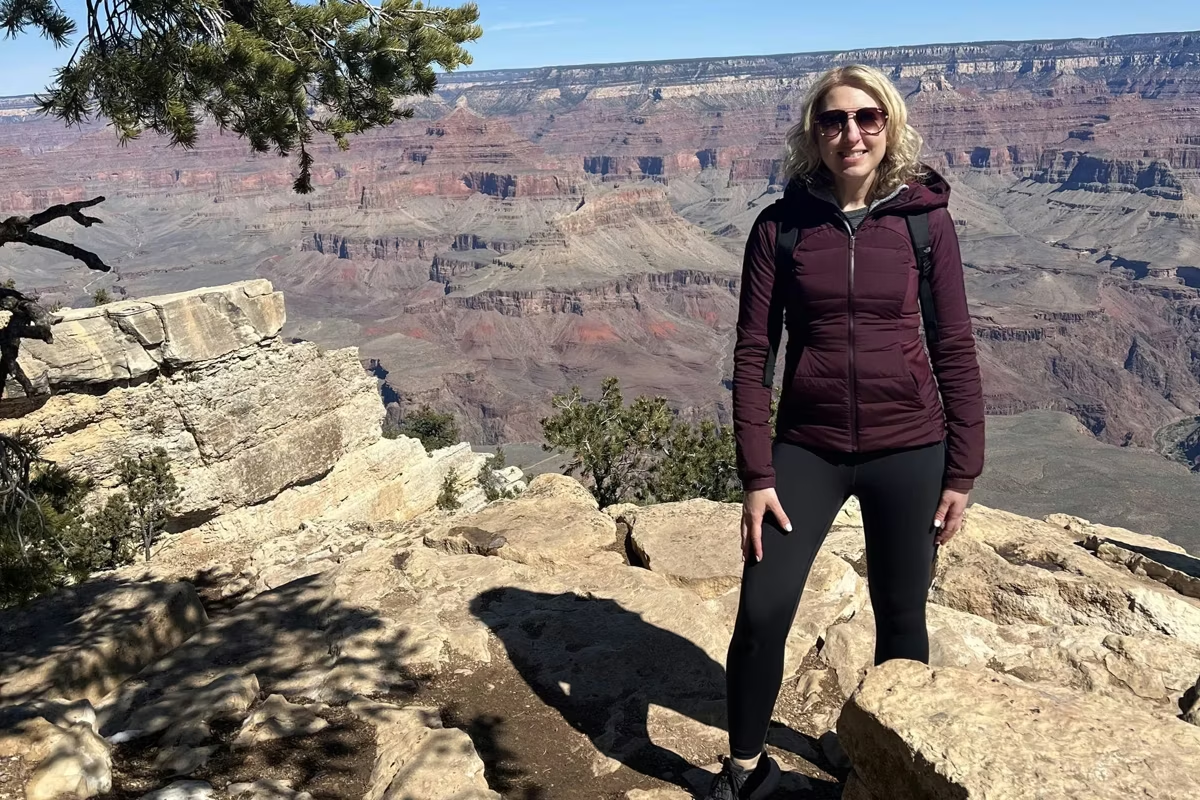
In high school, I started feeling not quite like myself, just a lot less energy than I usually had. It seemed perfectly normal to believe it was stress-related. School was getting more intense as college neared and then there was the normal teen stuff of dating and managing friendships.
In college, I began to have other symptoms like anxiety, nausea, lightheadedness, low appetite and trouble regulating my body temperature. In the dead of a freezing winter I’d be in the car with the windows rolled down. Even stranger: My skin had a slightly tan, jaundiced tint to it, especially around my joints.
I wondered if maybe my fast-paced life wasn’t catching up with me a bit, if maybe I was just stressed out.
I saw a primary care doctor who examined me and ran blood work. My labs all looked fine. And, even though I was losing some weight, I also looked fine — at least that’s what everyone told me. The slightly darker, slightly yellow tint to my skin actually got me compliments. “You look so tan,” people would say.
By the time I was reaching the end of college and preparing to go to grad school out of state, my symptoms had become nearly unbearable. I was so drained that just getting dressed in the morning felt like scaling a mountain. I couldn’t stand up without feeling dizzy. I had fainting spells out of the blue. I’d be walking across the room just fine and then collapse.
One primary care doctor checked me out and suspected my problem was a psychological one. He sent me to a psychologist who tried to hypnotize me. I went maybe twice at most, leaving with no diagnosis, no guidance and wholly convinced that my physical symptoms were all in my head.
I paid many visits to the ER, where I sought relief from nonstop vomiting, lightheadedness and abdominal pain. They’d say I was severely dehydrated and give me IV fluids. The fluids always made me feel better — but not for long.
I was hopeful that a cardiologist would have answers after putting me through various tests. He didn’t. One doctor prescribed me low blood pressure medication, which helped a bit with the dizzy spells, but my other symptoms raged on relentlessly.
I began to believe I was a lost cause.
Eventually I got so sick I had to take a semester off school and move back home. I was essentially bedridden and too weak to do much for myself.
My father ended up being the one who saved my life, in a sense. He heard a commercial on the radio where an endocrinologist was talking about rare autoimmune diseases. It was as though a little bell went off in our universe. Ding, ding, ding! Could this be it?
My parents took me to see an endocrinologist. Tests revealed that I did, in fact, have an autoimmune disorder: Addison’s disease. The severe symptoms I’d been experiencing for years were Addisonian crises, which occur when your adrenal glands do not produce enough of the stress hormone cortisol, which we all need to survive.
The endocrinologist told me I was lucky to be alive. A major Addisonian crisis can kill you.
Addison’s disease is rare and can be difficult to diagnose because routine tests often come back “normal.” Additionally, its symptoms can look like those caused by other conditions. You can also look perfectly healthy while your body is completely shutting down.
Many people living with Addison’s don’t get the right diagnosis initially. Like me, they may suffer for years thinking they have a mystery illness with no treatments.
When I finally received the diagnosis, I was so incredibly relieved. I’d been through so much. Not just in terms of symptoms, but in terms of tests. I’d had CT scans and even a spinal tap. I’d really started to think I wasn’t physically sick but psychologically unwell. I finally had an amazing doctor who truly understood what was happening to me and could help.
There’s no cure for Addison’s but it can be treated with corticosteroid medication. It’s a matter of getting the levels right in your body, and you’ll need to be on medication for life. You’ll also need to have your cortisol levels tested regularly to ensure proper dosing.
For me, there was some difficulty finding the right dose of medication. Initially, I felt a bit off. But once the dosing issue was ironed out, I felt like myself again. I was overjoyed, as were my family and friends. I got my life back. My prayers had been answered, and I felt so incredibly blessed.
Today I take a corticosteroid medication three times daily and a blood pressure medication in the morning. Stress and illness hits people with Addison’s disease very hard because we can’t produce enough cortisol to manage it. I do still sometimes end up going to the ER with a stress-induced Addisonian crisis (a high dose injection of cortisol gets me back on my feet). But most days, I’m stable.
Addison’s disease may be rare, but keep in mind that “rare” in this case still means tens of thousands of people around the world live with it. And while it can affect anyone, most of those diagnosed are women.
I’m hopeful that awareness of Addison’s disease will increase and that awareness will lead to an increase in funding for more research and education for medical experts. Had I known about autoimmune diseases including Addison's when I began experiencing symptoms, I likely would have been diagnosed right away and been spared years of debilitating symptoms and self-doubt.
But I focus less on the fact that it took years to get the diagnosis and more on the fact that I was lucky enough to finally get it. I’m grateful for my healthcare providers and my faith for guiding me to this point where I can be present with my family and friends to make each moment count.
Have your own Real Women, Real Stories you want to share? Let us know.
Our Real Women, Real Stories are the authentic experiences of real-life women. The views, opinions and experiences shared in these stories are not endorsed by HealthyWomen and do not necessarily reflect the official policy or position of HealthyWomen.