

Search
Latest Stories



Newsletter Sign-Up
Newsletter

Visit our Brain Health Hub.
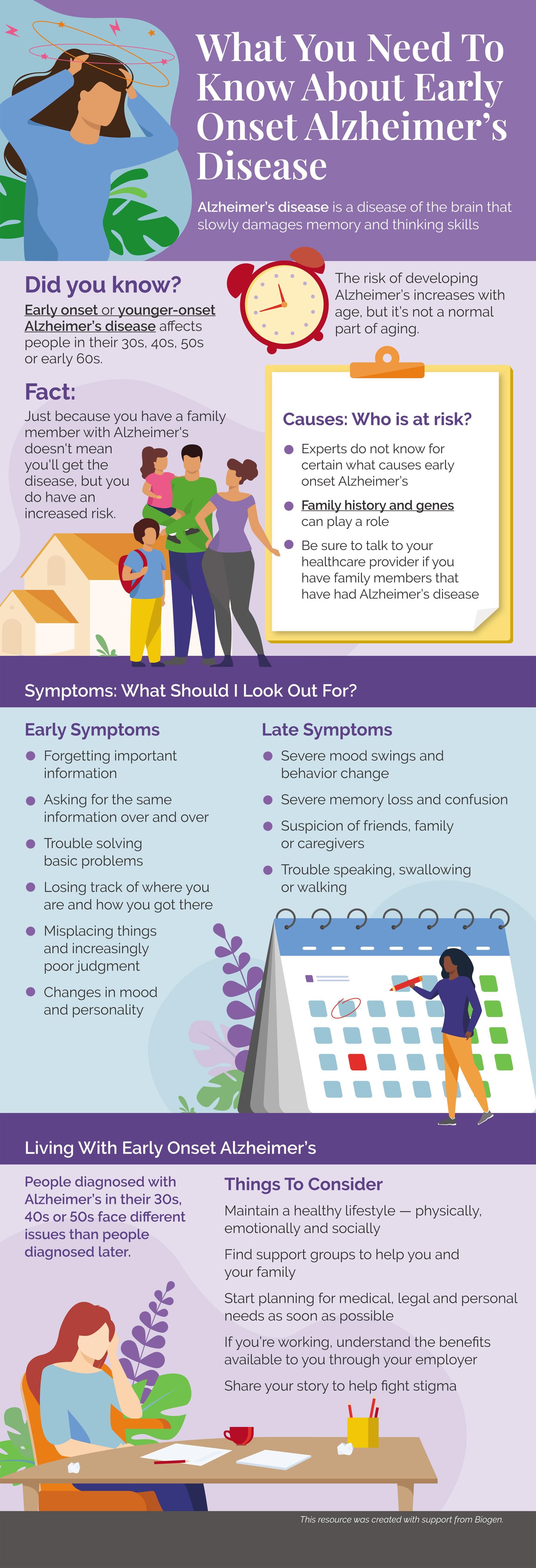
Alzheimer’s disease is a disease of the brain that destroys memory and thinking skills
The risk of developing Alzheimer’s increases with age; however, the disease is not a normal part of aging. |
Did you know? Alzheimer’s can affect people in their 30s, 40s or 50s. When Alzheimer’s occurs under the age of 65, it's known as early onset or younger-onset Alzheimer’s disease.
Causes: Who is at risk?
- Experts don’t know for certain what causes early onset Alzheimer’s
- The majority of people with early-onset have sporadic Alzheimer’s disease, which is the most common form of Alzheimer’s and isn’t caused by genetics
- Genes can play a role — although very rare, people who show symptoms in their 30s, 40s, or 50s may have genetic (familial) Alzheimer’s disease, which often affects family members in multiple generations
Fact: Inheriting one of the genes associated with familial lzheimer’s disease doesn’t mean you’ll necessarily develop Alzheimer’s. It does increase the risk if your parents or siblings have been diagnosed.
Symptoms: What Should I Look Out For?
Early Symptoms | Late Symptoms |
o Forgetting important things, new information or important dates o Asking for the same information multiple times o Trouble solving basic problems o Losing track of dates, time of year, where you are and how you got there o Misplacing things and increasingly poor judgement o Changes in mood and personality | o Severe mood swings and behavior change o Deepening confusion o Suspicion of friends, family or caregivers o Severe memory loss o Trouble speaking, swallowing or walking |
Living With Early Onset Alzheimer’s
People diagnosed with Alzheimer’s in their 30s, 40s or 50s face different issues than people diagnosed later.
Things to consider if you have early onset Alzheimer’s:
- If you’re working, understand the benefits available to you through your employer
- Start planning for medical, legal and personal needs as soon as possible
- Maintain a healthy lifestyle — physically, emotionally and socially
- Find support groups to help you and your family
- Share your story, if you’re comfortable, to help fight stigma
This resource was created with support from Biogen.







Popular
1
What Happens in the Body During a Hot Flash
Sep 03, 2026
2
Understanding Menopause Stages and Terms
Sep 08, 2026
3

4

Biologics for Treating Asthma
Sep 22, 2026
5
Lo que ocurre en el cuerpo durante un bochorno
Sep 03, 2026
6
Biofármacos para el tratamiento del asma
Sep 22, 2026
Support Our Mission
Keep Trusted Women’s Health Information Free
Your donation ensures every woman continues to have access to credible health content.More Stories




Everything you need to know about women’s health — in one place.