Making Sense of Your Thyroid Lab Results
Knowing how thyroid lab tests work can help you understand your results

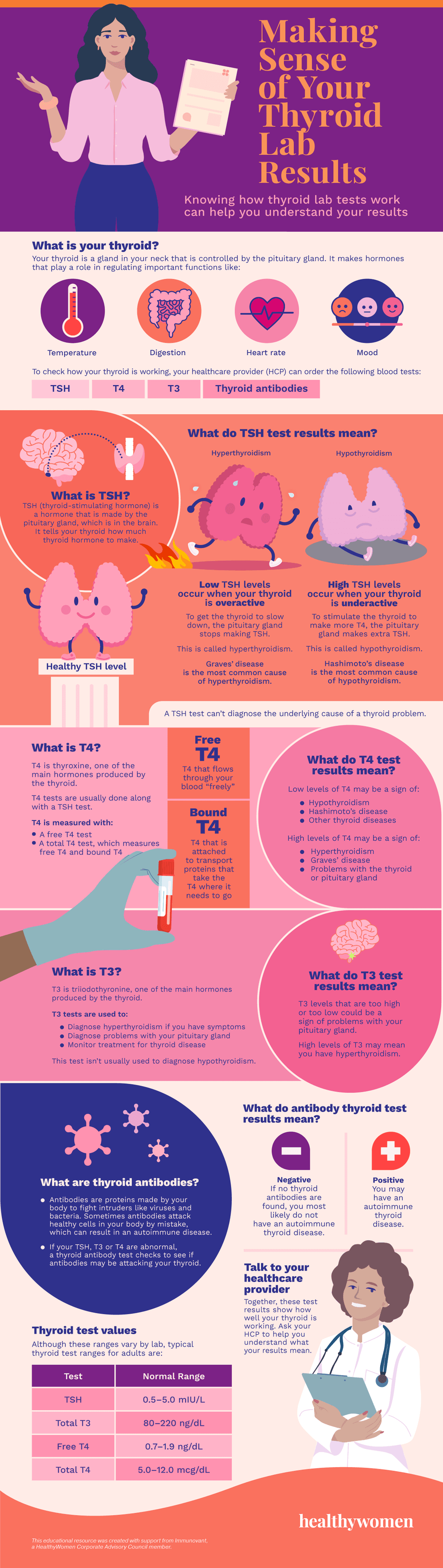
Your thyroid is a gland in your neck that is controlled by the pituitary gland. It makes hormones that play a role in regulating important functions like:
Body temperature
Digestion
Heart rate
Mood
To check how your thyroid is working, your healthcare provider (HCP) can order the following blood tests:
TSH
T4
T3
Thyroid antibodies
What is TSH?
TSH (thyroid-stimulating hormone) is a hormone that:
Is made by the pituitary gland, which is in the brain
Tells your thyroid how much thyroid hormone to make
What do TSH test results mean?
Low TSH levels occur when your thyroid is overactive
To get the thyroid to slow down, the pituitary gland stops making TSH
This is called hyperthyroidism
Graves’ disease is the most common cause of hyperthyroidism
High TSH levels occur when your thyroid is underactive
To stimulate the thyroid to make more T4, the pituitary gland makes extra TSH
This is called hypothyroidism
Hashimoto’s disease is the most common cause of hypothyroidism
A TSH test can’t diagnose the underlying cause of a thyroid problem.
What is T4?
T4 is thyroxine, one of the main hormones produced by the thyroid.
T4 tests are usually done along with a TSH test.
T4 is measured with:
A free T4 test
A total T4 test, which measures free T4 and bound T4
Free T4 = T4 that flows through your blood “freely”
Bound T4 = T4 that is attached to transport proteins that take the T4 where it needs to go
What do T4 test results mean?
Low levels of T4 may be a sign of:
Hypothyroidism
Hashimoto's disease
Other thyroid diseases
High levels of T4 may be a sign of:
Hyperthyroidism
Graves' disease
Problems with the thyroid or pituitary gland
What is T3?
T3 is triiodothyronine, one of the main hormones produced by the thyroid.
T3 tests are used to:
Diagnose hyperthyroidism if you have symptoms
Diagnose problems with your pituitary gland
Monitor treatment for thyroid disease
This test isn’t usually used to diagnose hypothyroidism.
What do T3 test results mean?
T3 levels that are too high or too low could be a sign of problems with your pituitary gland.
High levels of T3 may mean you have hyperthyroidism.
What are thyroid antibodies?
Antibodies are proteins made by your body to fight intruders like viruses and bacteria. Sometimes antibodies attack healthy cells in your body by mistake, which can result in an autoimmune disease.
If your TSH, T3 or T4 are abnormal, a thyroid antibody test checks to see if antibodies may be attacking your thyroid.
What do antibody thyroid test results mean?
Negative = If no thyroid antibodies are found, you most likely do not have an autoimmune thyroid disease.
Positive = You may have an autoimmune thyroid disease.
Thyroid test values
Although these ranges vary by lab, typical thyroid test ranges for adults are:
Test | Normal Range |
TSH | 0.5–5.0 mIU/L |
Total T3 | 80–220 ng/dL |
Free T4 | 0.7–1.9 ng/dL |
Total T4 | 5.0–12.0 μg/dL |
Talk to your healthcare provider
Together, these test results show how well your thyroid is working. Ask your HCP to help you understand what your results mean.
This educational resource was created with support from Immunovant, a HealthyWomen Corporate Advisory Council member.





Support Our Mission