I Couldn’t ‘Pray the Gay Away,’ so I Went to Conversion Therapy. It Nearly Killed Me.
I found my way to the truest, happiest version of myself through mindfulness and radical self-acceptance

June is Pride Month.
As told to Nicole Audrey Spector
I grew up in a chaotic household. There was a lot of moving around, anger and abuse. My parents divorced when I was 8. I never really knew what a healthy, happy family looked like, but I certainly knew what an unhealthy, unhappy family looked like.
By my teenage years, I was determined to be nothing like the adults around me.
In high school I found stability within a supportive friend group — kids who had the traditionally normal lives I’d always craved. They had happy families who did Sunday dinner and went on vacations together. They were also members of the Mormon church — not something I had any personal experience with but was increasingly curious about as I got closer with people in the faith.
My Mormon friends and their families attributed their structured, peaceful lives to God’s love. It was simple: If you lived by his rules as the Mormon church understood them, God would love you for all eternity. I’d never known a love like that, a love that would never abandon me.
At 16, I was baptized. Members of the Mormon church welcomed me with admiration and adoration.
A life of obedience in the Mormon faith means abstaining from all sexual thoughts and acts until you’re married. Once married, your main role as a woman is to be a wife and have babies. I was more than happy to sign up for all this, to check all the boxes that guaranteed God’s love, by overcoming feelings and desires.
At 20 I met Chad, a kind, respectful and smart young man in the Church who took an interest in me. I liked him as a person and I was flattered that he liked me. We were engaged and married within a year.
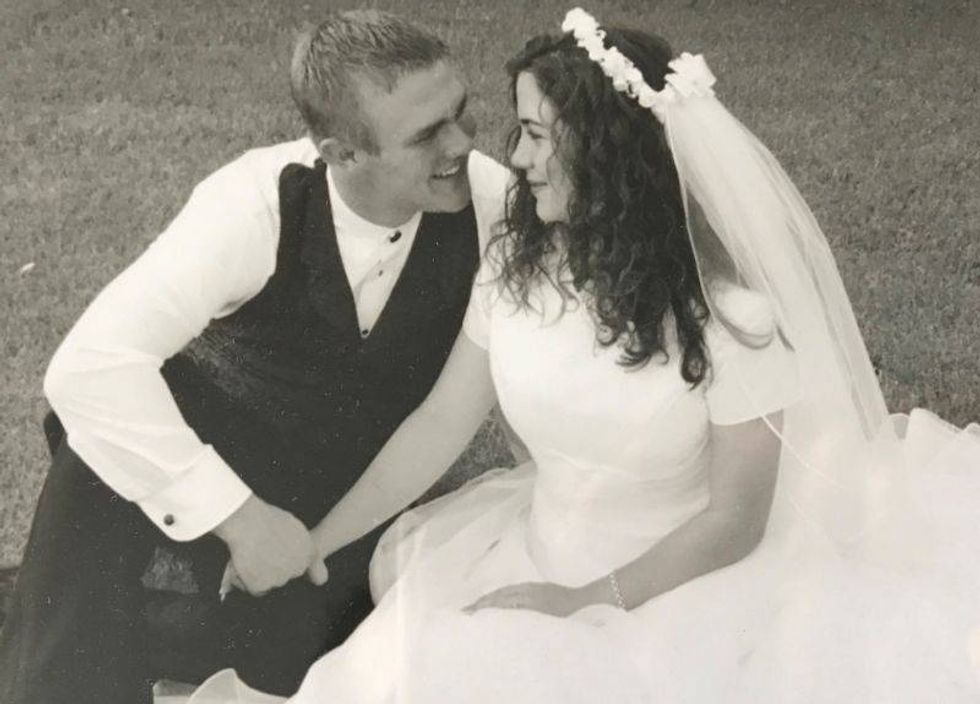 1999, Elena and Chad on their wedding day
We started trying to get pregnant soon into our marriage, as the Mormon church instructs. I played the role of an enthusiastic sexual partner, but I always felt disconnected and found myself wondering when sex would become the powerful, all-consuming force that the Church made it out to be. We lived in housing with other Mormon families, and the walls were thin. It sounded like the other women were having a better time than I was.
Sex may have been a let down, but motherhood was my chance to give my kids the healthy family life I hadn’t experienced. In Mormonism, once you’re sealed in the Temple (which you do through ongoing obedience), you’ve secured not only your eternity but also your children’s. So long as a mother follows the rules, not even death can separate her from her child. But if the mother breaks the seal by disobeying God’s rules, her kids could die tomorrow and she’d never connect with them again. I kept this threat of losing my children’s souls fearfully close to my heart.
In my mid-30s, when my youngest of four was in kindergarten, I started having sneaky little thoughts that I didn’t like my life. I found rigorous physical exercise to be a great way to distract me from these thoughts, but I could only run so many miles, lift so many weights before the thoughts crept back in. I got into fly fishing, which was absolutely thrilling and the best distraction.
I was one of six women in a fly fishing club that had 150 male members. One night, one of the other women, Kristen (not Mormon), approached me and said, “So I guess boobs only talk to other boobs, huh?” We laughed and a close friendship was born.
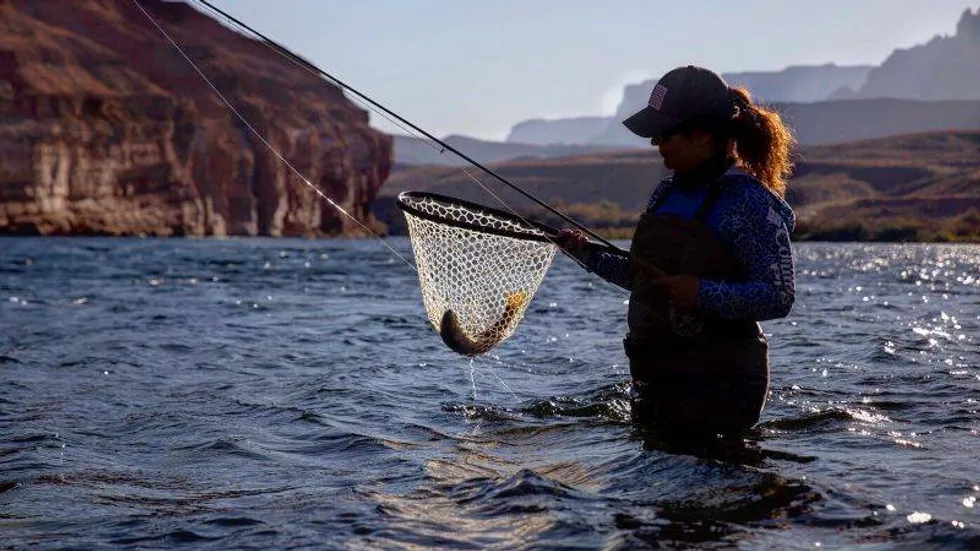 Fly fishing at the Grand Canyon, 2021
I’d never felt the way I did around Kristen. I thought feeling tingles and getting butterflies and going weak in the knees only existed for characters in romance novels. But they were real with Kristen. And she felt it too. Soon it became undeniable: Kristen and I were in love. I was gay. It was a horrific truth to face. Same sex attraction is a major sin in Mormonism. Loving a woman felt like a curse, and I wanted nothing but to break free of it. Yet I couldn’t.
Three weeks into our friendship, Kristen and I had our first kiss. It was magical — but right after it, Kristen said we shouldn’t see one another. She said it was too hurtful to see me in an unhappy marriage I didn’t seem willing to leave.
I couldn’t imagine a life without Kristen in it. I sent her a stream of text messages begging her not to leave me. Chad read those text messages one night when he went through my phone. He woke me up angry and upset. I was terrified and ashamed, thinking of how I could lose all my community and, most importantly, the eternal connection with my kids.
My rights within the Church were immediately stripped. I was no longer allowed to take the sacrament on Sundays or pray in public or teach a Sunday school class to kids. I tried so hard to repent by praying the gay away, as instructed by my community, but I couldn’t free myself of my attraction to women.
Desperate to save my marriage, my children and my soul, I enrolled in conversion therapy.
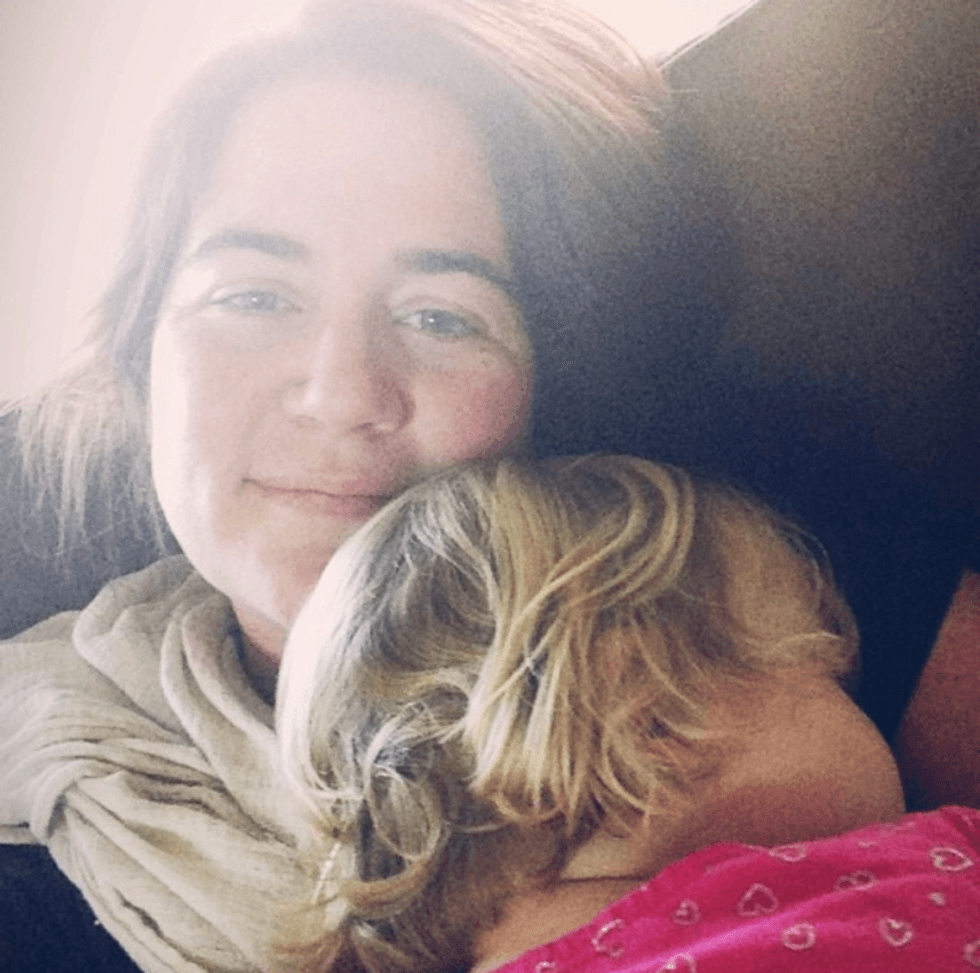 2014, Elena with one of her children
Conversion therapy, also called “reparative therapy” aims to change a person’s sexual or gender identity and is not supported by any major mental health organization, including the American Psychological Association. Many states have banned conversion therapy because it is both illegitimate and harmful. But it is not banned in Arizona, where we lived.
For two hours a day, four days a week, I went to conversion therapy. I started in August. By December I’d been on the verge of taking my own life three times. Once when I was just hours away from a suicide attempt, a friend stepped in and said, “You think taking your own life will stop the pain. It won’t. It just spreads it around.”
Those words broke through to me. And for the first time, I allowed myself to take a step back from the chaos of my pain and shame and just stop. Stop judging myself, stop hating myself, stop trying to make myself someone I wasn’t. I reached a place of calm and secure mindfulness, a space where I could accept who I was without putting myself on trial. In this clear, strong space, I realized that nothing mattered more to me than staying alive to be with my children — and for them to see me happy to be alive.
In this crystal-clear moment, I knew that being gay was something to be embraced at any cost. And what a cost it was. In the divorce, I lost almost my entire community. Years-long friendships vanished overnight. The love that would never abandon me abandoned me after all.
I was alone in a deafening silence. Just me and my thoughts. And all those thoughts were questions and criticisms and ultimatums. I got more serious about practicing mindfulness and meditated daily to teach my brain to be an observer, not a dictator.
Becoming mindful during the most painful crisis of my life wasn’t easy. The outside voices of condemnation were louder than ever. But the more I practiced mindfulness, the easier it became and the stronger I got. I became capable of making the brave changes that needed to be made in order to live an authentic, inspired life.
I divorced Chad, got my own place, came out to my children (they were not surprised nor were they upset) and built a beautiful career in public speaking and leadership development, with a focus on LGBTQ+ advocacy.
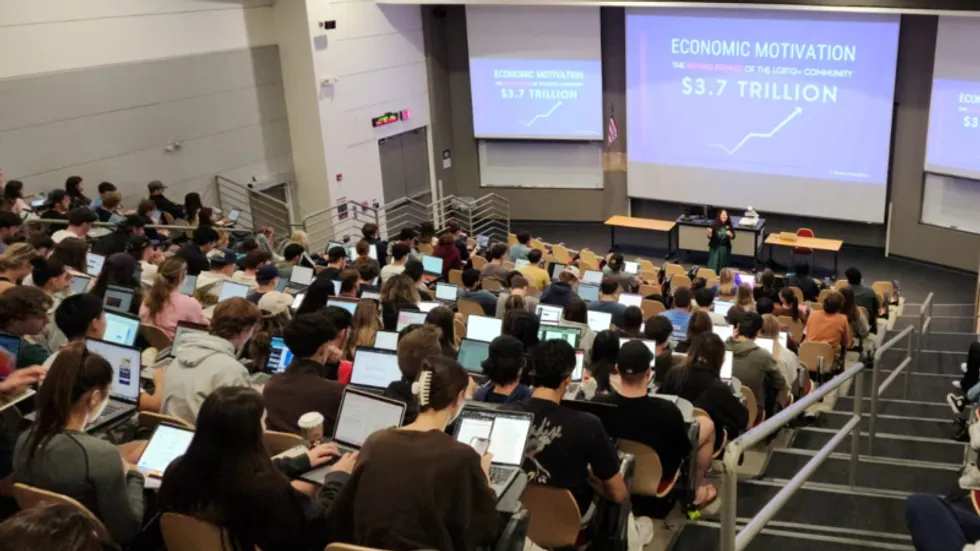 2022, Elena guest lecturing at the University of Arizona
It took me a long time to work through my internalized homophobia and become inclusive of all parts of myself. I did a lot of therapy with a queer non-Mormon therapist who could relate to aspects of my experience.
I studied quantum mechanics, which opened my mind to the concept that there are various versions of me out there and that what matters is being the highest version of myself that I can be. I no longer externalize God but instead look within for spiritual wisdom.
And as for eternal life … Well, I think consciousness is eternal. But are we connected to our loved ones, to our children, in an afterlife? I really don't know and I’m okay with not knowing because I’m no longer willing to live for heaven. I am living for now.
Have your own Real Women, Real Stories you want to share? Let us know.
Our Real Women, Real Stories are the authentic experiences of real-life women. The views, opinions and experiences shared in these stories are not endorsed by HealthyWomen and do not necessarily reflect the official policy or position of HealthyWomen.




Support Our Mission