Search powered by AI
Healthy Women Image

Jacquelyne Froeber

Senior Editor, HealthyWomen

Jacquelyne Froeber is an award-winning journalist and editor. She holds a BA in journalism from Michigan State University. She is the former editor-in-chief of Celebrated Living magazine and has editing and writing experience for print and online publications, including Health magazine, Coastal Living magazine and AARP.org.

As a breast cancer survivor, Jacquelyne encourages everyone to perform self-exams and get their yearly mammograms.

Full Bio
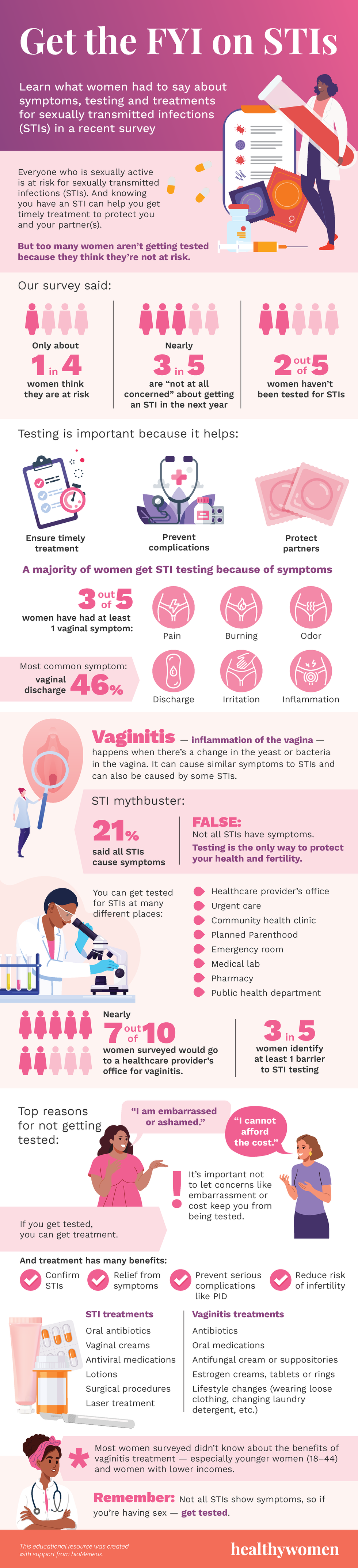
 Get the FYI on STIs infographic

Get the FYI on STIs

Learn what women had to say about symptoms, testing and treatments for sexually transmitted infections (STIs) in a recent survey

Conditions & Treatments

Get the FYI on STIs infographic. Click to view PDF.

Everyone who is sexually active is at risk for sexually transmitted infections (STIs). And knowing you have an STI can help you get timely treatment to protect you and your partner(s).

But too many women aren't getting tested because they think they're not at risk.

Our survey said:

  • Only about 1 in 4 women think they are at risk
  • Nearly 3 in 5 are "not at all concerned"about getting an STI in the next year

2 out of 5 women haven't been tested for STIs.

Testing is important because it helps:

  • Ensure timely treatment
  • Prevent complications
  • Protect partners

A majority of women get STI testing because of symptoms

3 out of 5 women have had at least 1 vaginal symptom:

  • Pain
  • Burning
  • Odor
  • Discharge
  • Irritation
  • Inflammation

The most common symptom: vaginal discharge (46%)

Vaginitis — inflammation of the vagina — happens when there's a change in the yeast or bacteria in the vagina. It can cause similar symptoms to STIs and can also be caused by some STIs.

STI mythbuster:

21% said all STIs cause symptoms.

  • FALSE: Not all STIs have symptoms.
    • Testing is the only way to protect your health and fertility.

You can get tested for STIs at many different places:

  • Healthcare provider's office
  • Urgent care
  • Community health clinic
  • Planned Parenthood
  • Emergency room
  • Medical lab
  • Pharmacy
  • Public health department

Nearly 7 out of 10 women surveyed would go to a healthcare provider's office for vaginitis.

3 in 5 women identify at least 1 barrier to STI testing

Top reasons for not getting tested

  • "I am embarrassed or ashamed."
  • "I cannot afford the cost."

It's important not to let concerns like embarrassment or cost keep you from being tested.

If you get tested, you can get treatment. And treatment has many benefits:

  • Confirm STIs
  • Relief from symptoms
  • Prevent serious complications like PID
  • Reduce risk of infertility

STI treatments

  • Oral antibiotics
  • Vaginal creams
  • Antiviral medications
  • Lotions
  • Surgical procedures
  • Laser treatment

Vaginitis treatments

  • Antibiotics
  • Oral medications
  • Antifungal cream or suppositories
  • Estrogen creams, tablets or rings
  • Lifestyle changes (wearing loose clothing, changing laundry detergent, etc.)

Most women surveyed didn't know about the benefits of vaginitis treatment — especially younger women (18–44) and women with lower incomes.

Remember: Not all STIs show symptoms, so if you're having sex — get tested.

This educational resource was created with support from bioMérieux.

You might be interested in
Trending Topics