

Search
Latest Stories

Newsletter Sign-Up
Newsletter
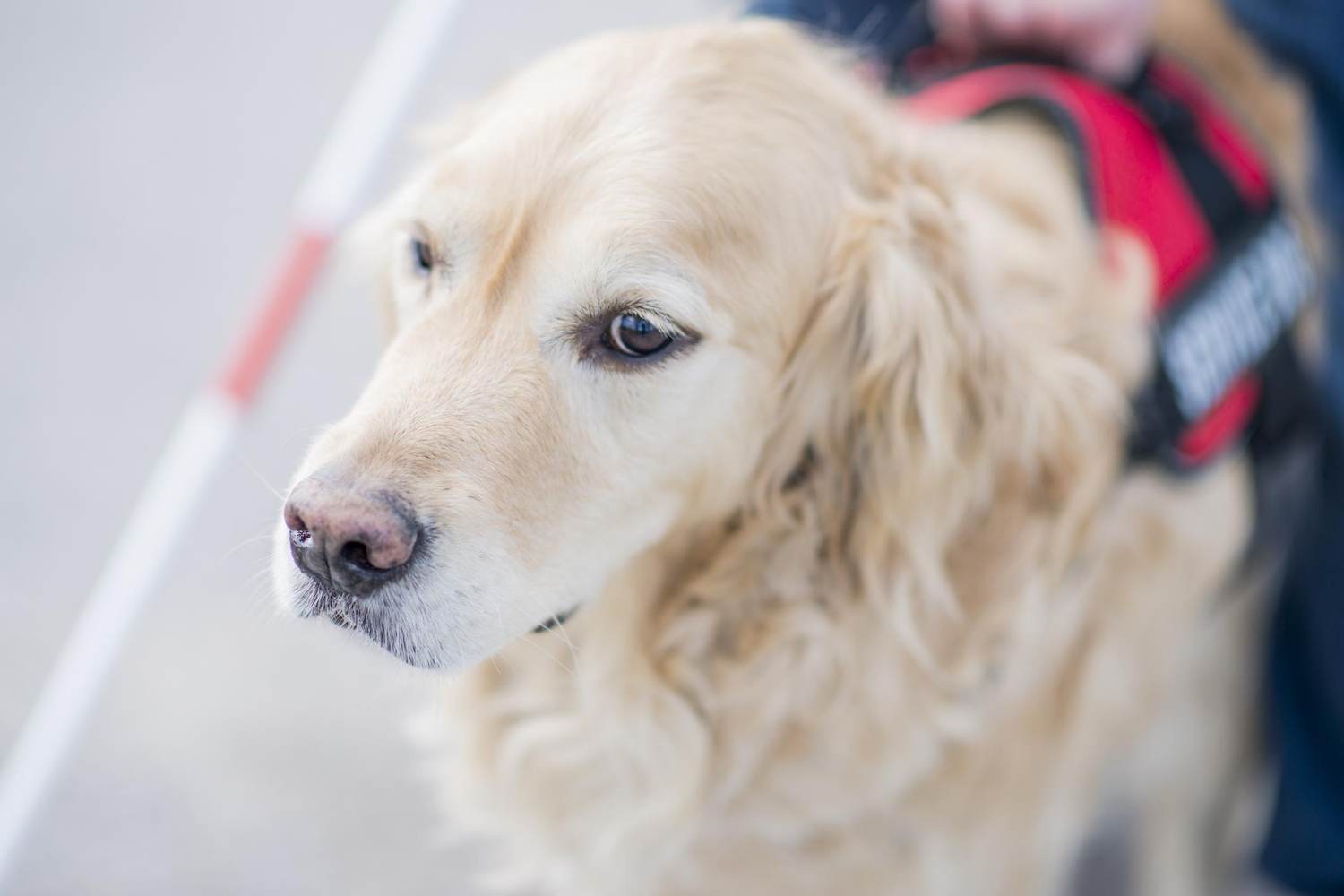
Lillian Carrier remembers the day vividly. She was shopping in Target with her service dog, Luke, when she noticed a lightbulb flickering and heard an awful screeching sound. She tried to ignore it, but it grew too much to bear for Carrier, who has autism. It threw her into a sensory overload, causing her to freeze and panic. But Luke, whom she'd had for only a few months, recognized Carrier's anxiety and did what he was trained to do: He grabbed her arm and pulled her to a safe place in the store. Then, he proceeded to lie on her, applying deep pressure for about 40 minutes before she was able to gain composure and call someone to pick her up.
"If he wasn't there, I don't know what I would have done because I don't want someone touching me. I don't know if I would have screamed or if I would have hit someone," Carrier said.
That was just one of the many times Luke, a golden retriever, has come to Carrier's rescue since he became her service dog three years ago.
The Americans with Disabilities Act defines service dogs as "dogs that are individually trained to do work or perform tasks for people with disabilities." And, according to the American Kennel Club, around 80 million Americans use service dogs for various needs.
Service dogs are used to help with various disabilities and include allergy-detection dogs, diabetic-alert dogs, hearing dogs, mobility-assistance dogs, psychiatric service dogs and even seizure-alert dogs.
While Carrier's service dog is for autism, Danielle Sykora, who is blind, uses her dog, Jackie, as a guide dog.
"When we're walking, she'll stop for any elevation changes, like curbs or stairs, and guide me around obstacles, so I don't walk into them," Sykora said. "And she can find specific things like a chair or an elevator or something like that."
Dogs assisting humans is not a new phenomenon, with the earliest evidence dating back to centuries ago. The first type of service dogs used during modern day were guide dogs for the blind, with the world's first guide dog school opening in Germany in 1916. In the 1970s, service dog usage began to expand to what we see today.
Brenda Kennedy, the vice president of canine health and research for Canine Companions, a service dog provider with locations around the country, said Canine Companions is the oldest dog assistance organization in the world that provides dogs for a variety of disabilities. Kennedy has been with the organization for seven years and heads up the company's research and breeding department. Through numerous studies, Kennedy and her team work to find quantitative data to show how service dogs benefit humans.
"We're trying to use more metrics and science-based processes to evaluate the impact of service dogs, as opposed to just using self-reporting from people," Kennedy said. "We're trying to get a lot more quantitative and look at things [such as] biomarkers like, what are the cortisol levels of someone? Do we see stress hormones change? Do we see sleep quality change?"
Canine Companions has been involved with several significant studies, including how domesticating dogs is what led to them being able to communicate with humans and whether their ability to communicate with humans is genetic. (Spoiler alert: It appears to be.)
Another large-scale study that Canine Companions participated in was conducted by the Department of Veterans Affairs (VA). The researchers looked at changes in veterans using service dogs and concluded that service dogs helped significantly reduce signs associated with post-traumatic stress disorder (PTSD). The study was so profound that President Biden signed the Puppies Assisting Wounded Servicemembers (PAWS) for Veterans Therapy Act. The act allows the VA to provide service dogs and provisions for their care to assist veterans with PTSD."We're putting out some of the data that's necessary to show it's not just sort of a warm and fuzzy thing. It's not just that dogs provide companionship; these are trained dogs that help people with disabilities mitigate some of the obstacles and challenges they face," Kennedy explained.
Canine Companions provides service dogs to people with disabilities for free, but many other organizations charge. And as more people with disabilities seek out service dogs, more scams pop up too. Waitlists for service dogs are often long, and once a person is placed with a pup, they frequently run into issues in the community regarding service dog laws.
According to the ADA, service dogs have full public access rights, which means they can go places where other animals aren't allowed, including restaurants, libraries, businesses, grocery stores, retail stores and public transportation. Service dogs can also board airplanes without their handler paying a pet fee.
In addition, when it's not obvious what service an animal provides, employees in public establishments can only ask two questions: (1) Is the dog a service animal required because of a disability, and (2) What work or task has the dog been trained to perform? According to the ADA, staff can't ask about a person's disability, require medical documentation, require a special identification card or training documentation, or request that the dog demonstrate its ability to perform the work or task.
However, people in the community still don't know these laws, and as a result, people like Sykora and Carrier often experience discrimination.

Lillian Carrier and Luke, 2021
"It's a strange thing that I'm always advocating for disability and service dog laws because no one is aware of them," Carrier explained. "When I go grocery shopping, when I go to restaurants, if there's a new place, there's always something that I have to explain to someone," Carrier said.
"I think people should all be trained on what service dog law is if you're working with people."








Popular
1

What Happens in the Body During a Hot Flash
Sep 03, 2026
2

Understanding Menopause Stages and Terms
Sep 08, 2026
3

4
Biologics for Treating Asthma
Sep 22, 2026
5

6
Lo que ocurre en el cuerpo durante un bochorno
Sep 03, 2026
Support Our Mission
Keep Trusted Women’s Health Information Free
Your donation ensures every woman continues to have access to credible health content.More Stories








Everything you need to know about women’s health — in one place.