

Search
Latest Stories





Newsletter Sign-Up
Newsletter
Don't Miss Out
Get the latest updates and insights delivered to your inbox.

Nicole Pajer
Nicole Pajer is a freelance writer published in The New York Times, Parade, AARP, Woman's Day, Men's Journal and beyond.
When she's not writing, she's checking exotic travel destinations off her bucket list, attempting to wear out her 71-pound Doberman's boundless energy and teaching people how to properly pronounce her last name ("It's Pager, just like the beeper!"). Keep up with her adventures on Twitter @NicolePajer.
Full BioLearn about our editorial policies
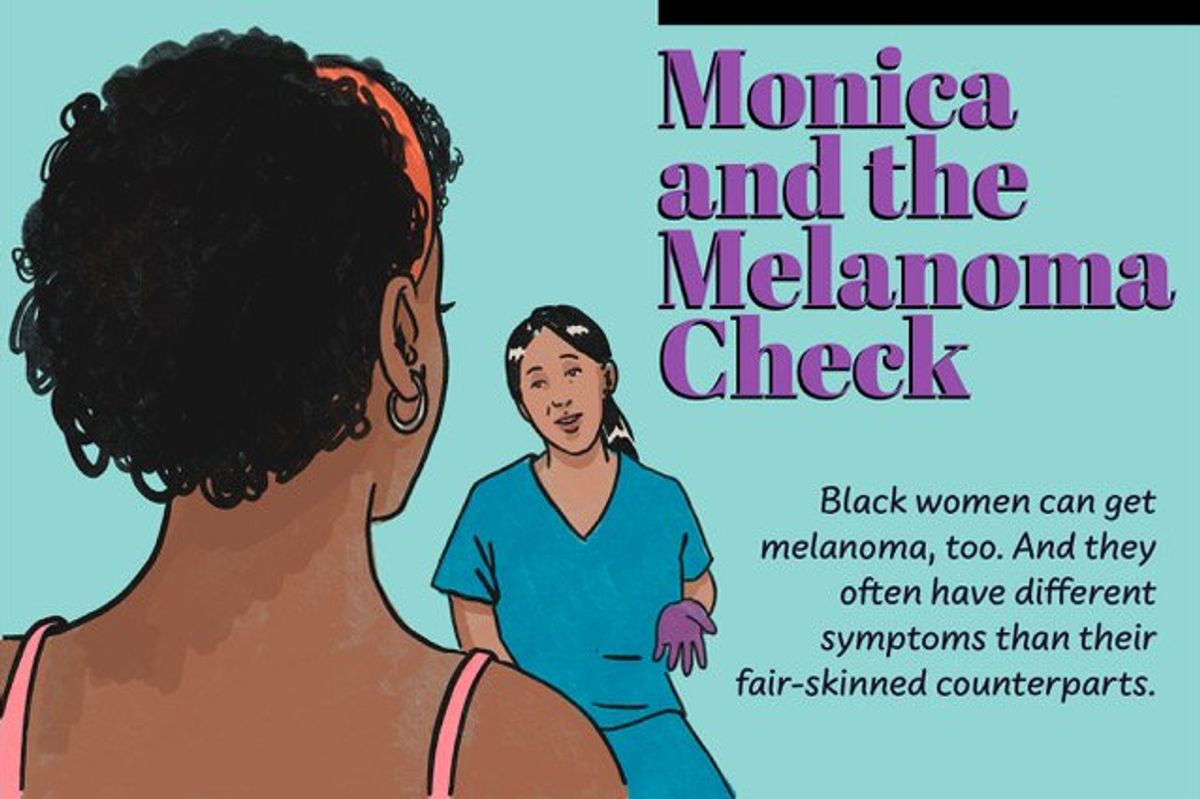
Comic: Monica and the Melanoma Check
Black women can get melanoma, too. And they often have different symptoms than their fair-skinned counterparts.
Dec 09, 2024
Conditions & Treatments Medically Reviewed
Image | Dialogue |
Two Black women (Monica and Brandi) are sitting at a table at an outdoor cafe having lunch together and chatting. | Monica: What are you going to wear to Stacey’s party next month? Brandi: Probably a black dress. The one with the — Monica: (reaches for her glass of water, exposing a dark spot on her palm in the process) Brandi: Monica, what’s on your hand? Monica: This spot? (points to spot on palm). Not sure. It seemed to just show up one day. And you know what? It’s actually been bothering me lately. It’s itchy and a little tender. Brandi: Have you gotten it checked out? Monica: No. I’m sure it’s no big deal. Brandi: That kinda reminds me of how Stacey said her skin cancer looked. Monica: But she’s fair-skinned. Darker skinned people like us don’t have to worry about that. I never get burned. Brandi: Yeah, but I think you should at least get it looked at.
|
Monica is sitting in the examination chair at the dermatologist’s office. She is finishing up one of those fancy laser treatments on her face. | A couple weeks later … Doctor: All done! This should help fight some of those fine lines you’re concerned about. Monica: Oh before I go, my friend made me promise to ask you about this spot on my hand. I told her it was nothing, but can you take a quick look? |
Monica’s dermatologist reaches for a magnifying glass, adjusts her headlamp to shine onto her palm, and leans forward and examines the mole on her palm. Monica’s doctor takes a quick skin sample of the mole and packages it up for biopsy. | Doctor: This actually looks a bit suspicious. Monica: Really? What does it look like? Doctor: It could be early melanoma. Monica: On the palm of my hand? Doctor: Yes. In people with darker skin, melanoma actually shows up more in areas that don’t get a lot of sun, like your palm, bottoms of the feet, under your nails or even inside your mouth. Monica: I had no idea. I barely even use sunscreen – unless I’m at the beach or something – because my skin never seems to burn. Doctor: A lot of people of color don’t realize that they’re also prone to skin cancer. And that not all skin cancer is caused by sun exposure. It’s true that lighter skin is more at risk, but I also diagnose it in Black people — even those who never burn. I’m going to have this biopsied and will call you with the results. |
Monica gets a phone call from the doctor. | Monica: Hello? Doctor: Hi, Monica. Just like I suspected, that mole is early stage melanoma. The good news is you brought it to my attention, and we caught it early. I’m going to schedule you to come in and get it removed. Monica: Wow. I’m so glad I had it checked. Doctor: Yes, it’s great that you brought that mole to my attention. Come in for yearly checks, keep tabs on your skin between appointments and definitely come see me if you notice anything else suspicious. Also, even though sun exposure probably didn’t cause this melanoma, it’s still important to wear sunscreen. Use SPF 30 or higher. You’ll want to find a brand with zinc oxide and/or titanium dioxide. Zinc can leave a white cast on your skin, but they make tinted ones for people of color. Monica: Thank you! |
Monica is at Stacey’s party with her friend Brandi. They are standing together at a high top cocktail table with a drink in each of their hands chatting. Brandi is in her black dress and Monica is dressed up as well. The party is outside on a rooftop and the sun is still out. Monica puts on sunscreen and offers some to Brandi | Monica: Thanks again for encouraging me to get that mole checked out, Brandi. Brandi: Of course. I’m so glad the surgery took care of it. A great reminder to put on sunscreen. Honestly, I’ve been slacking too. Monica: Speaking of which … (pulls out a tube of SPF 30, slathers some on her exposed skin and offers it to Brandi). Brandi: Thanks! |
Possible skin cancer symptoms in people of color
| |
For more information, visit HealthyWomen.org. | |
This resource was created with support from Merck. | |
From Your Site Articles
- Why Are People of Color More Likely to Die from Skin Cancer? ›
- Fast Facts: What You Need to Know About Skin Cancer ›
- How to Conduct a Skin Cancer Self-Exam If You Have a Darker Skin Tone ›
- The ABCDEs of Spotting Melanoma ›
- I Thought I Was Too Young to Get Melanoma - HealthyWomen ›
Related Articles Around the Web
You might be interested in



For many women, a urinary tract infection (UTI) is an uncomfortable but relatively straightforward experience: Burning with urination, frequent trips to the bathroom and a course of antibiotics to clear the infection.
But sometimes, a UTI can become much more serious, or “complicated,” particularly when an infection moves beyond the bladder or happens alongside other health conditions that make it harder to treat.
Mindy Norlian learned just how serious a UTI could become after years of frequent infections following menopause. At one point, while Norlian was at work, one of those infections progressed to sepsis, requiring hospitalization and IV antibiotics.
“I started getting really sick and vomiting,” Norlian said. “They had to call 911 because I was delirious.”
Norlian’s experience highlights why women, particularly postmenopausal women who are at higher risk for UTIs, should understand the difference between common UTIs and complicated UTIs (cUTIs), the symptoms of each, and when it’s time to seek medical attention.
What is a cUTI?
Simple, or common UTIs, most frequently occur in the bladder and are usually caused by a bacteria that’s easy to treat. Complicated UTIs are infections that can occur anywhere in the urinary tract system and are more difficult to treat or have an increased risk of serious problems and complications.
“A simple UTI is usually just a plain old bladder infection,” explained Rebecca Lane, M.D., a urogynecologist with 18 years of experience.
“A complicated UTI is an infection that has progressed beyond the bladder and probably up to the kidney,” Lane said. “It can also occur when an infection is difficult to [get rid of] because of resistant bacteria or health conditions such as diabetes or a compromised immune system.”
One of the most significant complications of a UTI is a kidney infection. In severe cases, bacteria can also enter the bloodstream and potentially lead to sepsis, a life-threatening response to infection.
Why UTIs become more common after menopause
Urinary tract infections are one of the most common bacterial infections in women, with around 50%–60% of women developing UTIs sometime in their lives. After menopause, around 10% to 15% of women experience recurrent or complicated urinary tract infections.
Menopause itself isn't necessarily what makes a UTI “complicated.” But it does create changes that can make urinary infections more common.
The reason largely comes down to estrogen.
Estrogen helps support the tissues and environment of the vagina and urinary tract, keeping them elastic and moist. As estrogen levels fluctuate during perimenopause and decline postmenopause, that environment changes, often thinning vaginal tissues, causing dryness and irritation.
“The low-estrogen environment in the bladder postmenopause makes the bladder a more hospitable place for the bacteria to set up, reproduce and stay,” Lane said.
For Norlian, she'd had urinary problems as an infant because of an unusually narrow urethra but said she didn't experience significant problems with UTIs until after menopause.
For several years, she recalled experiencing UTIs as frequently as once or twice a month. She eventually learned that her urethra was bent, although she wasn't retaining urine, and her doctors didn't blame all of her infections on that anatomical difference.
She suspected the timing of her frequent infections wasn't coincidental.
“I still believe that I got a lot of them because of the hormones that were doing less and less,” Norlian said.
How can you tell if a UTI is becoming serious?
A typical bladder infection may cause burning or pain when urinating, a persistent urge to urinate and increased urinary frequency.
The symptoms that should raise more concern are those suggesting that the infection has moved beyond the bladder.
“If you're having fevers, throwing up or having back pain, those are signs that you might have a kidney infection,” Lane said.
Those symptoms can mean that what started as a bladder infection has progressed and needs more intensive treatment.
Symptoms can also be less obvious in some older adults. Lane noted that an infection may sometimes be considered when an older patient develops an unexplained change in mental status.
Norlian experienced that firsthand: She remembers becoming delirious when her infection progressed to sepsis. She was hospitalized and treated with a strong IV antibiotic.
How are cUTIs treated?
Treatment for cUTIs depends on how severe the infection is and where it's located.
An uncomplicated bladder infection is generally treated with a short course of oral antibiotics. Broad-spectrum antibiotics are generally the first course of action. A cUTI typically requires a longer course of antibiotics since the infection is severe and often caused by bacteria that are resistant to treatment. Although some cUTIs require hospitalization for treatment, some patients may be able to receive oral treatments at home.
“If you're able to keep antibiotics down, you don't necessarily need to be hospitalized for a complicated UTI or kidney infection,” Lane said.
But someone who is vomiting and unable to keep oral medication down may need to go to the hospital for IV antibiotics. Severe infections, including those that have entered the bloodstream, can also require hospitalization.
Because antibiotic resistance can make some infections more difficult to treat, determining which bacteria are causing the infection and selecting an appropriate antibiotic may also become important.
Can postmenopausal women prevent UTIs?
For Lane, one of the most important tools that she uses to help prevent bladder infections and avoid cUTIs in postmenopausal women is vaginal estrogen.
Vaginal estrogen is a prescription hormone therapy used to treat changes caused by low estrogen levels during or after menopause. Vaginal estrogen is used directly in the vaginal area and restores estrogen to vaginal and urinary tissues.
There are other preventive strategies that women may think about as well. Lane mentioned cranberry extract and vaginal probiotics as possible options, although she emphasized vaginal estrogen as the primary preventive approach she recommends.
A gynecologist may also prescribe low-dose antibiotics for six months or more to help keep UTIs at bay for some women. Although this is an effective approach, long-term use of antibiotics is also linked to antimicrobial resistance, which can ultimately make UTIs harder to treat.
There are also a variety of over-the-counter supplements available that claim to prevent UTIs, but women considering supplements should discuss them with a clinician. Evidence supporting UTI supplements varies, and supplements can interact with medications or health conditions.
There are behavioral and lifestyle changes that can help too, such as drinking plenty of fluids daily to dilute urine and flush out bacteria, emptying your bladder after sex, and avoiding holding urine for long periods of time during the day.
Don't ignore a changing UTI
Postmenopausal women who find themselves dealing with UTIs shouldn't assume they simply have to live with them. Talking with a clinician about why the infections are happening and figuring out their options is an important step toward preventing complicated UTIs and their ripple effects.
For Norlian, finding a prevention strategy that worked has made a dramatic difference after years of frequent and sometimes frightening infections.
She has also learned to recognize her symptoms early and take them seriously.
Her experience is an important reminder for other postmenopausal women: Getting treatment for a UTI shouldn’t be delayed, and talking to a clinician about prevention and treatment options may help women find relief — and avoid a cUTI.
This educational resource was created with support from GSK.
Nicole Pajer
Nicole Pajer is a freelance writer published in The New York Times, Parade, AARP, Woman's Day, Men's Journal and beyond.
When she's not writing, she's checking exotic travel destinations off her bucket list, attempting to wear out her 71-pound Doberman's boundless energy and teaching people how to properly pronounce her last name ("It's Pager, just like the beeper!"). Keep up with her adventures on Twitter @NicolePajer.
Medically reviewed by Lakshi Aldredge, MSN, NAP-BC, DCNO